
Last updated September 24, 2026
Attic Insulation Maintenance Checklist for La Habra Homeowners
Blown cellulose that entered a La Habra attic at R-38 can settle to R-28 within eight years under normal conditions - a 26% performance loss that no homeowner will feel suddenly but every energy bill will reflect incrementally. Most maintenance checklists tell you to “look for damage” from the attic hatch. That’s not enough. In La Habra’s climate, with Santa Ana wind events, seasonal temperature swings, and the specific construction patterns of postwar tract homes and 1990s rebuilds, insulation fails in ways a visual scan misses. This guide gives you exact measurements to take, photographs to record, and the numerical thresholds that separate normal aging from performance failure.
Quick Answer
Attic insulation maintenance in La Habra means measuring settled depth at nine points across the attic floor annually, photographing four penetration types after any HVAC service, and checking for three specific failure modes: thermal bridging at trusses, pest compression with a probe rod, and Santa Ana wind-driven dust loading at eave vents. For a deeper look at how these factors affect your home, see The Complete Guide to Insulation in La Habra. If settled depth falls more than 15% below original specification, or if probe readings show density above 2.5 lbs/ft³ in cellulose, the insulation has degraded past adequate performance and needs professional evaluation.
Table of Contents
- Why Standard Checklists Fail in La Habra Attics
- The Depth-Ruler Protocol: Nine Measurement Points
- Santa Ana Wind-Driven Dust Loading and Compaction
- Identifying Rodent Runway Compression vs. Normal Settling
- The Four Penetrations to Re-Inspect After HVAC Service
- What to Record Annually: Your Documentation System
- Thermal Bridging at Trusses: The Hidden Heat Path
- Common Mistakes to Avoid
- When to Call a Professional
- Frequently Asked Questions
- The Bottom Line
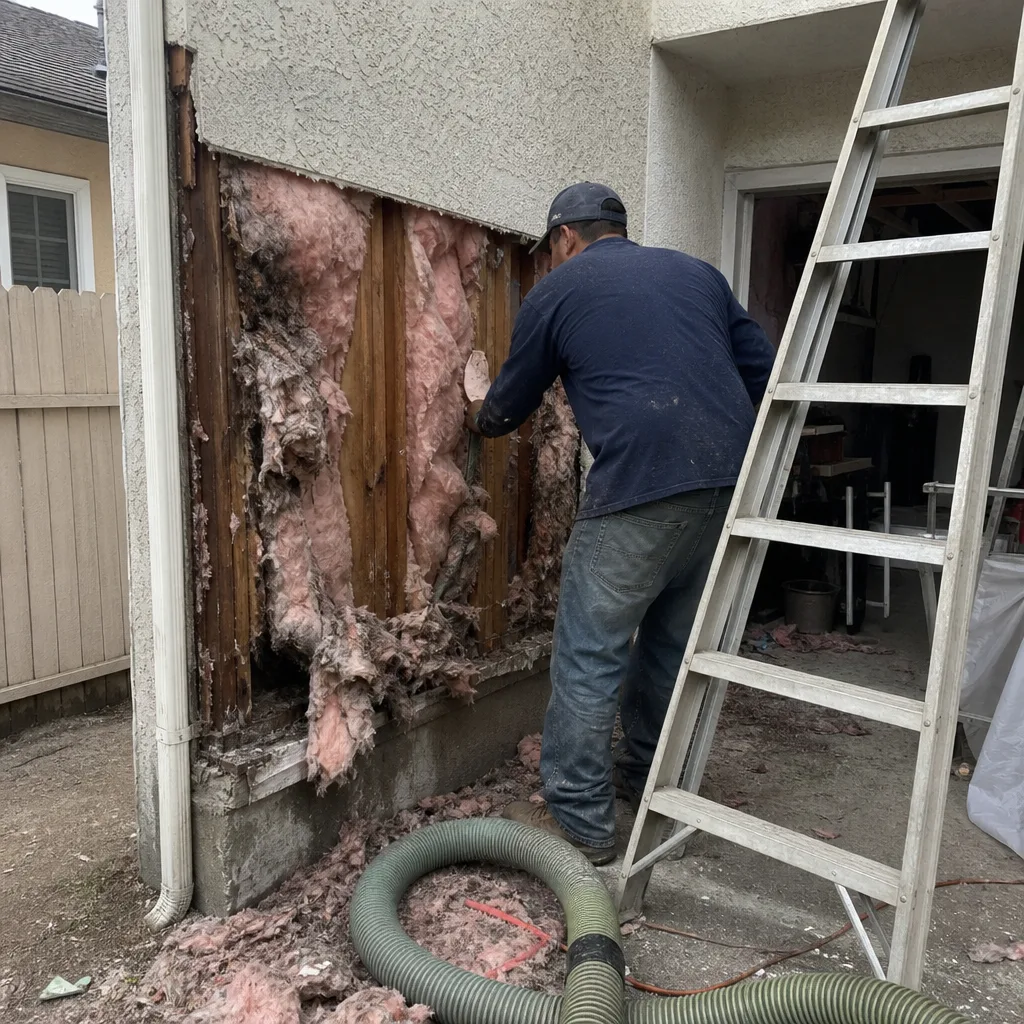 Before
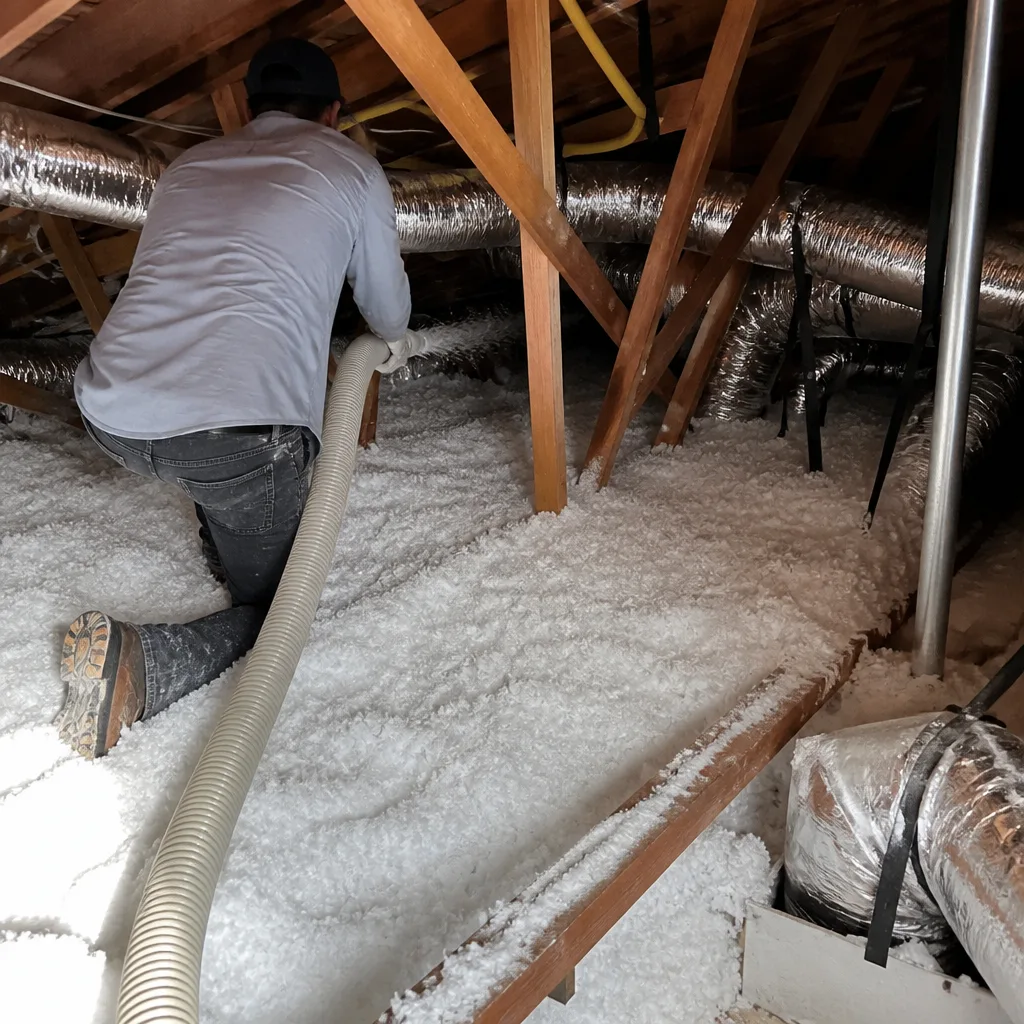 After
AfterWhy Standard Checklists Fail in La Habra Attics
Generic attic insulation advice assumes a Midwestern climate: steady cold, predictable humidity, and attics built to hold snow load. La Habra’s conditions break that model. We’re in Orange County’s transition zone between coastal marine influence and inland heat, which means attics here hit 140°F in August and drop to near-ambient in winter - thermal cycling that accelerates settling. The Santa Ana winds arrive dry and fast, carrying particulate through eave vents that weren’t designed for that loading. And the housing stock is specific: 1950s-1970s tract homes with shallow-pitch roofs and minimal original insulation, plus 1990s-2000s rebuilds with complex rooflines and vaulted ceilings that create uneven thermal zones.
Standard checklists tell you to “check for moisture” or “look for pest damage.” They don’t tell you that a La Habra attic with original R-19 batts compressed by three decades of storage traffic might read R-12 in practice, or that blown cellulose near eave vents can form a dense crust that appears intact while the center has settled two inches. We’ve inspected attics in the Boulevard District where homeowners reported “the insulation looks fine” and we found a 40% performance loss measurable only with a ruler and a probe.
The checklist below replaces visual guesses with quantitative checks. It assumes you can access your attic safely with a ladder, headlamp, and basic tools. If your attic has active electrical hazards, steep pitch, or limited framing to walk on, skip to the section on when to call a professional, or read DIY vs Professional Insulation: The La Habra Homeowner’s Decision Guide to decide what’s right for you.
The Depth-Ruler Protocol: Nine Measurement Points
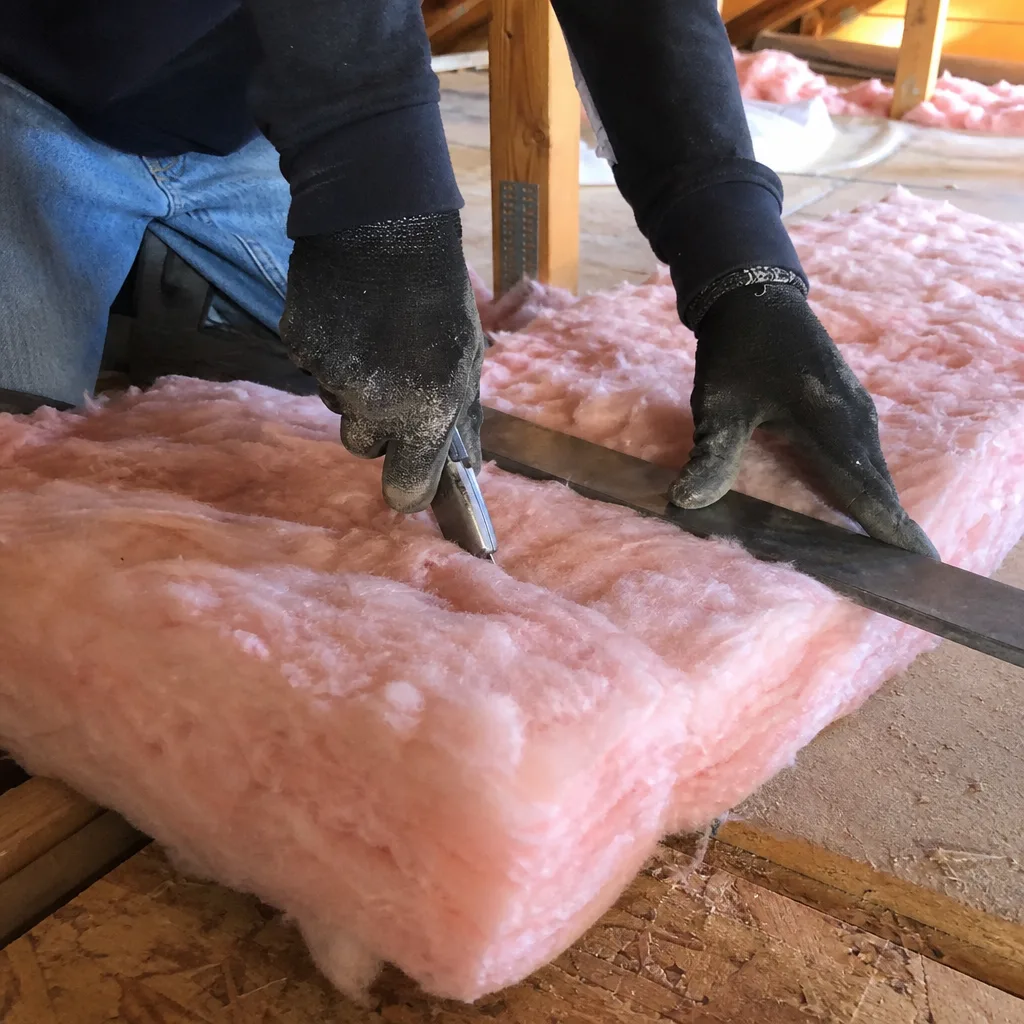
Depth measurement is the foundation of attic insulation maintenance. Settling is normal and expected; uneven settling is the problem. In La Habra’s flat-ceiling tract homes and vaulted additions, insulation settles differently across the footprint due to traffic patterns, HVAC vibration, and roof geometry.
The Nine-Point Grid
Mark a simple grid on paper before you enter the attic. You’ll take readings at:
- Center of attic: The geometric middle of the floor, away from any HVAC equipment or storage.
- North eave: Within 24 inches of the north eave vent, measured perpendicular to the slope.
- South eave: Within 24 inches of the south eave vent - in La Habra, this typically receives more sun loading and more Santa Ana wind exposure.
- East eave: Within 24 inches of the east eave.
- West eave: Within 24 inches of the west eave.
- Mid-span north: Halfway between center and north eave.
- Mid-span south: Halfway between center and south eave.
- HVAC plenum zone: Within 36 inches of any furnace or air handler platform - vibration accelerates settling.
- Attic hatch perimeter: Within 12 inches of the access opening - traffic compression zone.
How to Measure
Use a rigid yardstick or dedicated insulation depth ruler, not a flexible tape. Push vertically through the insulation until you hit the drywall or plaster ceiling below. For blown-in material, wiggle slightly to find the true top surface without compressing it. Record to the nearest quarter-inch.
For batts, measure uncompressed thickness at the edge of a batt where you can see the full depth. Don’t measure where the batt is already compressed by a walk board or storage.
What the Numbers Mean
| Original Specification | Minimum Acceptable (15% loss) | Replacement Threshold |
|---|---|---|
| R-38 blown cellulose (~10-12 in.) | 8.5-10.2 in. | Below 8.5 in. |
| R-30 blown cellulose (~8-9 in.) | 6.8-7.7 in. | Below 6.8 in. |
| R-19 fiberglass batt (6.25 in.) | 5.3 in. | Below 5.3 in. |
| R-38 fiberglass batt (12 in.) | 10.2 in. | Below 10.2 in. |
If your nine-point readings vary by more than 2 inches between any two points, you have uneven settling. This is common in La Habra’s vaulted ceiling additions, where insulation slides toward the eave over time. Uneven settling creates thermal bypasses - the center of your ceiling might perform at R-38 while the eave performs at R-22.
Compare your readings to any original installation documentation you have. If the attic was insulated by Topside Attic Insulation La Habra home or another contractor, the invoice or scope should list original depth and material type. No documentation? Assume the original spec matched common La Habra code requirements: R-30 for attics insulated before 2019, R-38 for work done under current Title 24 standards.
Santa Ana Wind-Driven Dust Loading and Compaction
This is the failure mode almost no checklist covers, and it’s specific to Southern California inland valleys. Santa Ana wind events push fine particulate - dust, pollen, ash from regional fires - through eave and soffit vents. In La Habra, which sits at the northern edge of Orange County with direct exposure to Santa Ana corridors, this loading is heavier than in coastal cities.
The mechanism: wind-driven particles enter eave vents and deposit on the first few feet of insulation. Over years, this forms a dense surface crust, typically ½ to 2 inches thick, that reads as “insulation” to a casual look. Beneath the crust, the material may have settled normally. The crust itself has minimal insulating value - compacted dust and debris is essentially R-1 per inch. More critically, the crust can bridge across truss bays and create a false floor that hides deeper settling below.
What to Look For
- Color change at eaves: The first 24-48 inches of insulation from any eave vent should match the center in color. Gray or brown discoloration, especially in a gradient that darkens toward the vent, indicates dust loading. Normal cellulose weathers to a uniform tan; uneven darkening is suspect.
- Surface crusting: Press a finger into the insulation surface. It should yield easily. A crust that resists initial pressure, then breaks through to softer material below, is compacted dust loading.
- Edge feathering on batts: Fiberglass batts near vents should have distinct, fluffy edges. If edges are matted and blend into the surrounding material, wind has been working on them.
Photograph This
Take three photos per eave zone: a wide shot showing the vent and insulation relationship, a close-up of the insulation surface texture, and a photo with your depth ruler inserted to show crust thickness. Date these photos. In our experience across La Habra homes near Imperial Highway and Idaho Street, dust loading accelerates after major Santa Ana events - the October-December 2022 wind season produced measurable compaction in attics we inspected the following spring.
If dust loading exceeds 1 inch of compacted crust across more than 25% of the eave perimeter, professional cleaning and re-insulation is warranted. The crust cannot be effectively removed without disturbing the underlying insulation, and disturbed blown-in material rarely resettles to original performance.
Identifying Rodent Runway Compression vs. Normal Settling
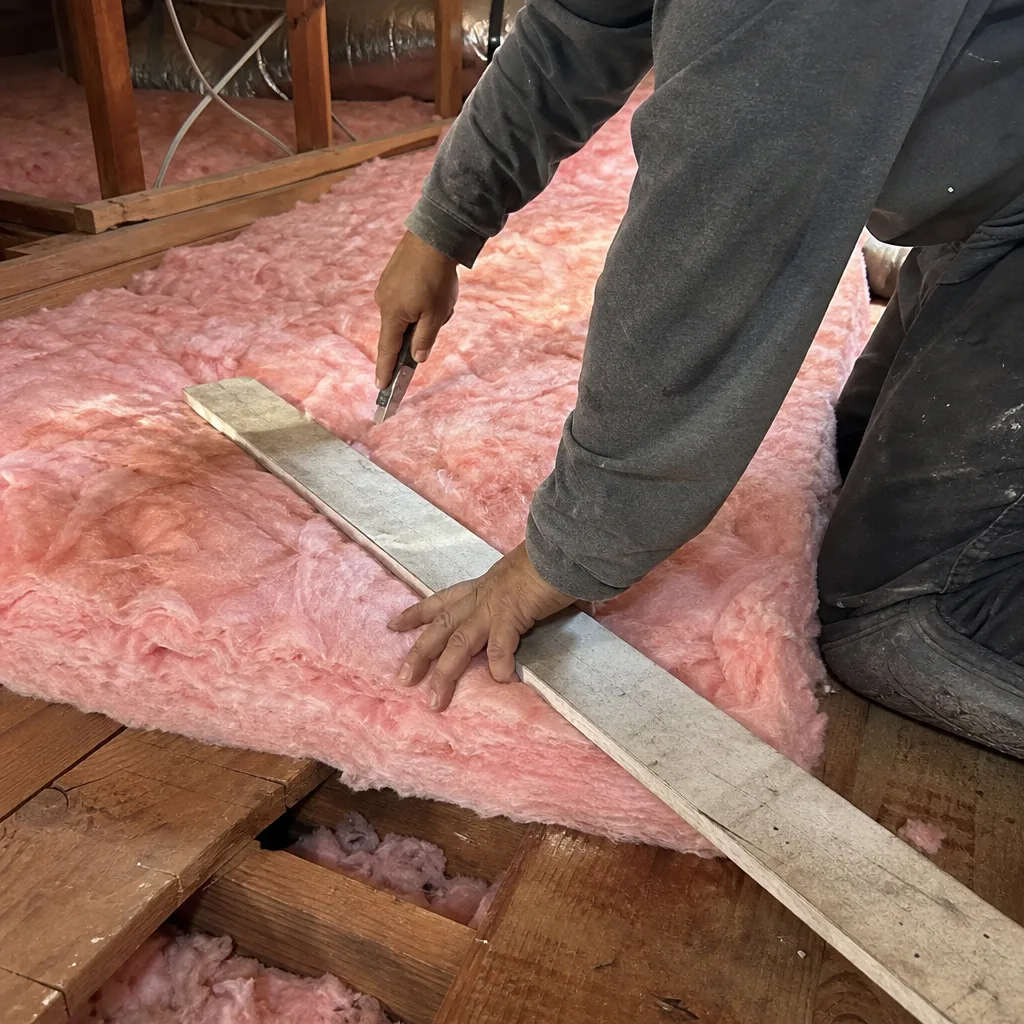
La Habra’s mature tree canopy and proximity to wilderness interface zones create persistent rodent pressure. Roof rats and mice use attics as transit corridors, and their repeated traffic compresses insulation into runways that read as paths of lower depth. Normal settling is uniform; runway compression is linear and localized.
The Probe Rod Test
A probe rod - a ¼-inch steel rod with a T-handle, available at any hardware store - is the tool for this check. At each of your nine depth measurement points, push the rod vertically through the insulation with gentle, consistent pressure. Record the depth where resistance changes significantly.
Now probe in a grid pattern between your nine points, spacing probes 24 inches apart. You’re mapping density variation. Normal blown cellulose at R-38 has a settled density of roughly 1.5-2.0 lbs/ft³. Runway compression pushes this to 2.5-3.5 lbs/ft³ in the traffic path. The probe will feel different: a sharp increase in resistance, then a possible void below if rodents have tunneled.
Visual Confirmation
Runways have signatures beyond probe feel:
- Linear paths: Compression follows routes between eave and roof peak, or along joist tops - the paths of least structural interference for small animals.
- Grease staining: Rodent fur deposits oils that darken insulation along runways. This is visible against light-colored cellulose or fiberglass.
- Droppings: Obvious but often missed - pellets accumulate at runway endpoints or near heat sources.
- Nesting material: Shredded insulation concentrated in a single bay, with compressed approaches.
The Threshold Decision
If probe readings exceed 2.5 lbs/ft³ equivalent (you’ll feel this as “harder than the surrounding area by a clear margin”) in linear patterns totaling more than 10 linear feet, or if any single runway exceeds 3 feet, the insulation requires remediation. Compressed insulation in runways performs at roughly 40-60% of original R-value. More critically, rodent activity indicates envelope breaches that will admit new pests and conditioned air loss.
In La Habra’s Westridge and Eastside neighborhoods, we’ve found that homes with original 1960s-1970s construction and mature fruit trees nearby have the highest runway incidence. The combination of accessible eave vents, minimal original air sealing, and abundant food source creates persistent pressure.
Attic Insulation in La Habra work by qualified contractors includes rodent proofing as a prerequisite to new insulation - never insulation over active infestation.
The Four Penetrations to Re-Inspect After HVAC Service
Any HVAC service call that accesses the attic disturbs the air sealing and insulation around penetrations. This is not the technician’s fault - it’s the nature of working in confined spaces with tools and equipment. But it creates a maintenance trigger that most homeowners miss.
After any HVAC service, inspect these four penetration types within 48 hours:
- Top plates: The horizontal framing member where interior walls meet the ceiling. HVAC flex duct, low-voltage wiring, and plumbing vents often pass through here. Original air sealing is typically caulk or foam that cracks with age. Service traffic can dislodge it further. Look for visible gaps, fallen caulk beads, or insulation pulled away from the penetration.
- Recessed can lights: Older non-IC (insulation contact) cans create a 6-8 inch insulation-free zone. If insulation was pushed back for service and not replaced, you have a direct thermal bypass. Even IC-rated cans benefit from sealed covers - check that covers are seated after any work above them.
- HVAC boots and plenums: The sheet metal connections where ductwork enters conditioned space. Mastic sealant can crack; flex duct connections can loosen. Look for detached insulation wraps, gaps in mastic, or daylight visible around boot flanges.
- Attic hatches: The access door itself is a penetration. Weatherstripping compresses over time. If the hatch was removed and replaced during service, the seal may be compromised. Check for even compression of the weatherstrip - a gap at any corner is significant.
Photograph each penetration after service. Compare to your baseline photos from the previous year. Changes are easier to spot in side-by-side comparison than in memory.
In La Habra’s 1990s-era homes with complex HVAC zoning, we’ve documented that post-service penetration gaps account for 15-25% of callback complaints about “the system not keeping up.” The equipment is fine; the envelope has been breached.
What to Record Annually: Your Documentation System
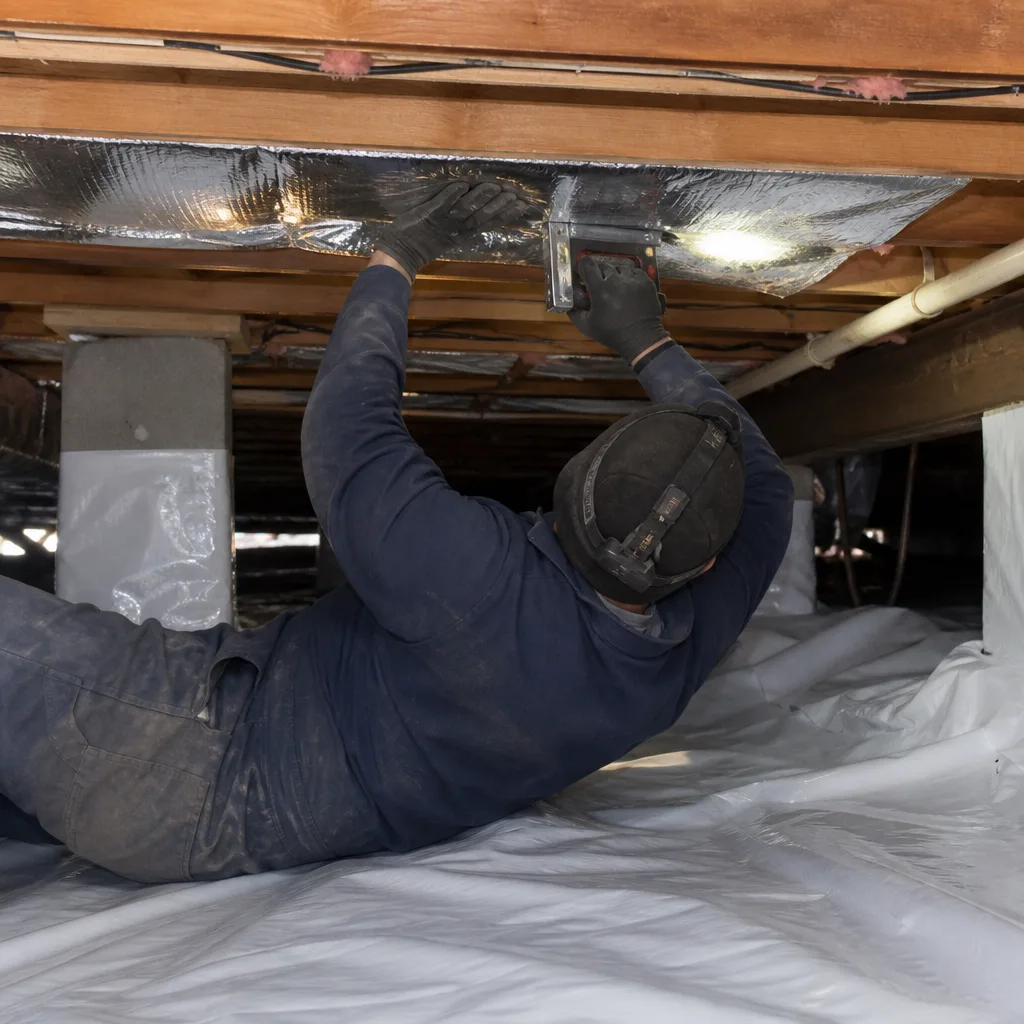
Documentation transforms maintenance from guesswork into data. When you eventually sell your La Habra home or call a contractor for evaluation, a five-year record of depth readings, photos, and observations is more valuable than any verbal description.
The Annual Record
Create a simple spreadsheet or paper log with these fields:
- Date: Month and year of inspection.
- Depth readings: All nine points, in inches, to quarter-inch precision.
- Depth variance: Maximum reading minus minimum reading. Flag if over 2 inches.
- Dust loading notes: Yes/no at each eave, with photo file names referenced.
- Rodent evidence: Yes/no, with location description and photo file names.
- Penetration condition: Intact/gaps noted, per the four types above.
- Moisture staining: New or changed stains on roof deck or ceiling drywall - describe location and approximate size.
- HVAC service since last inspection: Date and contractor, if applicable.
Photo Organization
Store photos in a dated folder with consistent naming: “2024-10_attic_center_depth.jpg”, “2024-10_north_eave_dust.jpg”. This discipline pays off when you need to show a contractor what changed. We’ve resolved disputes in La Habra homes where our photo record from the original installation, compared to the homeowner’s annual photos, proved that settling was within normal parameters - or that a roof leak had saturated insulation in a specific bay.
What to Compare Against
If you have original installation documentation, file it with your annual records. Key numbers to preserve: original material type (cellulose, fiberglass, mineral wool), original depth, original R-value claim, and any blower-door test results if air sealing was performed. Spray Foam Insulation in La Habra jobs should include the foam type and thickness - open-cell Icynene or Demilec products perform differently over time than closed-cell formulations.
Without original documentation, use your first comprehensive inspection as your baseline. The value is in the trend, not the absolute first reading.
Thermal Bridging at Trusses: The Hidden Heat Path
This is the failure mode your hand will feel before your eye sees it. In winter, stand below any exterior wall and move your hand across the ceiling. Cold strips, typically 1.5 inches wide and aligned with truss locations, indicate thermal bridging - the truss wood conducts heat faster than the insulation surrounding it, creating a localized cold path.
In La Habra’s climate, thermal bridging is more pronounced than in milder coastal areas because the inland temperature swing is wider. A January night can hit 40°F while the attic drops below that. The delta-T (temperature difference) drives heat loss, and trusses provide the highway.
How to Assess
From the attic, look for:
- Insulation pulled away from truss chords: Common in blown-in installations where material doesn’t fill tightly against the wood. A visible gap of even ½ inch creates a convection loop.
- Compressed batts at trusses: Installers often walk on truss chords, compressing batts there while leaving bays fluffy. The chord zone then underperforms.
- Truss uplift: Seasonal movement of the truss bottom chord can crack ceiling drywall at wall intersections and dislodge insulation. Look for ceiling cracks below as a symptom, then verify insulation displacement above.
The Advanced Check: Infrared Verification
If you have access to a thermal camera (some libraries lend them, or hire an auditor), scan the ceiling on a morning after a cold night. Truss locations will show as cooler strips if bridging is active. The pattern is unmistakable: regular, parallel lines matching your truss spacing, typically 24 inches on center in La Habra’s postwar construction, 16 inches in some 1990s builds.
Mitigation requires dense-pack cellulose or spray foam at the truss chord, or rigid foam strips above the deck before re-roofing. This is not a DIY fix - the materials and air sealing detail are specific. But identifying it annually lets you budget and plan, rather than discovering it when your energy bill spikes.
Common Mistakes to Avoid
- Measuring only at the attic hatch: The hatch zone is the most compressed, most trafficked, and most wind-exposed area. It will read lower than the attic center in almost every case. Nine points minimum, or you’re measuring your own footsteps.
- Confusing storage platforms with insulation performance: La Habra homeowners often install plywood walk boards or storage platforms. These compress insulation below and create thermal bypasses. Measure under platforms separately, and consider whether the storage is worth the R-value loss.
- Ignoring the “it looks fine” trap with blown cellulose: Cellulose weathers to a uniform color that hides depth variation. A surface that looks even can conceal two inches of differential settling. The ruler doesn’t lie; your eyes do.
- Skipping post-HVAC inspection because “they’re professionals”: HVAC technicians are professionals at HVAC. They’re not insulation installers, and they’re not responsible for your envelope. Check their work zone within 48 hours, every time.
- Waiting for a comfort complaint to inspect: By the time you feel cold spots or high bills, performance loss is typically 25-40%. Annual inspection catches degradation at 10-15%, when correction is cheaper.
- Adding new insulation over old without addressing air leaks: This is the most expensive mistake. New insulation over an unsealed attic performs like a sweater with holes. In La Habra’s climate, air sealing first - top plates, penetrations, chimney chases - typically improves performance more than an extra R-10 of insulation.
- Using a household broom or rake to “fluff” settled insulation: This breaks fiber bonds in cellulose and tears fiberglass batts. Fluffing is not restoration. If material has settled past threshold, remove and replace.
When to Call a Professional
Call a contractor for our Attic Insulation services when your annual inspection reveals any of these: depth below replacement threshold at any point, runway compression exceeding 10 linear feet, dust loading with crust over 1 inch, moisture staining on roof deck or ceiling, or active rodent evidence. Also call if your attic has knob-and-tube wiring, steep pitch beyond safe walking, or if you’re uncomfortable with ladder access.
Crawl Space Encapsulation & Vapor Barrier in La Habra may also be relevant if your home has moisture migration from below affecting attic conditions.
Topside Attic Insulation La Habra offers free estimates in La Habra - call (562) 267-3291. Every estimate includes a written price before any work starts, a documented photo record of conditions found, and on applicable jobs, before-and-after blower-door numbers so you can verify the air-sealing result. We’ve sealed and insulated over 9,000 homes since 2016, every one with that documentation. The 365-Day Done Right Promise applies to all completed work.
Frequently Asked Questions
Inspect annually, ideally in October before the heating season begins. La Habra’s Santa Ana wind season runs October through March, so a pre-season check lets you document conditions before peak wind loading and address any issues before winter energy demand peaks. Call (562) 267-3291 if your inspection reveals concerns - estimates are free.
Most attic insulation jobs in a La Habra home of 1,200-2,000 square feet run between $2,800 and $5,400 for blown-in cellulose or fiberglass, including air sealing of top plates and penetrations. Spray foam at the roof deck runs higher, typically $4,500-$8,500 depending on accessibility and foam type. These ranges reflect 2024-2025 material and labor costs in Orange County. Every job by Topside Attic Insulation La Habra begins with a written price before any work starts - no exceptions. Call (562) 267-3291 for an exact quote on your specific attic.
You can only if the old insulation is dry, uncontaminated, and the attic floor has been properly air sealed first. In our experience across La Habra, roughly 60% of attics with original insulation lack adequate air sealing at top plates and penetrations. Adding insulation over leaks is like adding a thicker blanket with holes in it - the performance gain is minimal. We never blow new material over an unsealed attic floor; the air sealing comes first, always.
Check that eave vents are unobstructed by insulation and that ridge or gable vents show daylight without blockage. In La Habra’s climate, the ratio should be approximately 1 square foot of net free vent area per 300 square feet of attic floor, with balanced intake at eaves and exhaust at ridge. Santa Ana winds can drive rain through poorly screened vents - look for water staining on the roof deck near vent locations. If vents are blocked by dust-laden insulation crust, airflow is compromised and moisture risk rises.
For attic floors, dense-pack cellulose or mineral wool (Rockwool) resists settling and pest activity better than loose-fill fiberglass in our experience. Rockwool’s higher density and fire resistance are advantages in wildfire-adjacent areas, though it costs more. For roof deck applications, closed-cell spray foam provides air sealing and insulation in one pass, but requires careful moisture management. We source materials from Knauf, Rockwool, CertainTeed, Icynene, and other manufacturers - no proprietary lock-in, so we specify what fits the home’s conditions and your priorities.
Typically no - standard policies exclude rodent damage as a maintenance issue. The insulation replacement and rodent proofing are out-of-pocket. However, some insurers offer endorsements for pest-related damage. Document everything with photos for any claim attempt. In La Habra, we recommend addressing rodent proofing before re-insulating; otherwise, new insulation becomes new nesting material within a season.
Properly installed, air-sealed, and unmolested attic insulation should perform for 20-30 years. But “properly installed” is the key condition. In La Habra’s actual housing stock, with Santa Ana wind exposure, seasonal thermal cycling, and the rodent pressure common to mature neighborhoods, we see measurable performance degradation at 8-12 years for blown cellulose, 12-15 years for fiberglass batts. Annual inspection with the depth-ruler protocol catches this before it becomes a comfort or cost problem.
The Bottom Line
Attic insulation maintenance in La Habra is not a visual check from the hatch. It’s nine depth measurements, a probe rod test for density variation, documentation of dust loading at eaves, and re-inspection of four penetration types after any HVAC service. The numbers matter: 15% depth loss is your warning threshold, 2.5 lbs/ft³ probe resistance indicates runway compression, and 1 inch of dust crust signals Santa Ana degradation. Record annually, compare to your baseline, and act before comfort complaints or bill spikes force the issue. The homeowners who maintain their attics quantitatively avoid the emergency replacement cycle that hits when ignored insulation finally fails. For more guides & resources on keeping your home efficient, explore our blog.
Written by Wes Okafor, Owner at Topside Attic Insulation La Habra, serving La Habra since 2016.